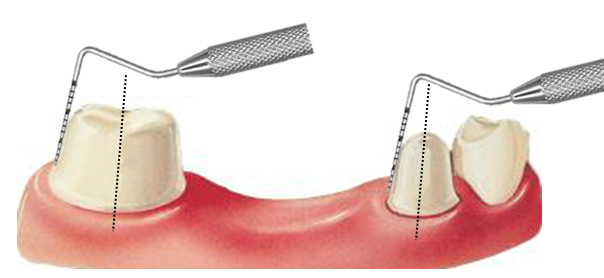
The principles and technique that goes with single crown preparation also applies to posterior fixed bridges, the only difference is that you have to do it on two teeth. The tricky thing with posterior bridges is to how to put the line line of draw of both crowns parallel. Parallelism is very important to create an ease of placement of the bridge on to the prepared crown. Books may tell you to close one eye to check for undercuts and deviation from the line of draw but it doesn’t work for everybody. Sometimes it is very hard to teach this that actually it seems that somehow this is an acquired skill to have.
However, through simpler ways of demonstration, we can check the parallelism by looking at the walls itself. With the use of a perio probe or any straight instrument, check every aspects of one crown if it also parallels with the same surface that you are checking on the other crown. For example, the mesial wall of the premolar should be parallel to the mesial wall of the molar too. Since crowns are made to a uniform 3 dimensional shape, all aspects and walls of the crown should be parallel all throughout.